LG CNS has established an organizational framework to prevent environmental risks and implement environmental management practices. The Public Affairs/ESG Bureau oversees company-wide environmental management, formulates climate change strategies, and manages compliance with the Emissions Trading System (ETS). In parallel, the Data Center Operations organization manages key environmental indicators, including energy, water, and waste. Furthermore, we regularly report key environmental performance and implementation plans to the Board of Directors and formal committees, systematically responding to the requirements of internal and external stakeholders.
Environment_Management1_2607.png)
LG CNS has established and implements an Environmental Management Policy that reflects key stakeholder requirements and aligns with global standards.
We systematically manage greenhouse gas emissions by actively responding to the Emissions Trading System (ETS). To ensure a global-level management system, we have obtained and maintain ISO 14001 and ISO 50001 certifications, which are international standards for environmental and energy management. Through these efforts, we strive to enhance environmental management standards across our business operations and reduce energy consumption.
As AI technologies continue to advance, data center power consumption is steadily rising due to the increasing computing resources required to train and operate AI models, as well as the expansion of data-intensive services such as cloud computing, IoT, and streaming platforms. To respond to this trend, LG CNS is accelerating the adoption of ultra-high-efficiency thermal management teghnology, Immersion Cooling, to build environmentally friendly data centers that serve as core infrastructure for future technologies, including AI, Big Data, and IoT. We are systematically establishing verification environments to assess the technology’s ability to effectively manage heat generated by high-performance computing systems while maximizing energy efficiency. Through these efforts, LG CNS is validating performance and stability, securing operational capabilities, and preparing for full-scale deployment.
Environment_Datacenter_Goal.png)
LG CNS provides enterprise-wide online ESG training to raise employee awareness of the environmental impacts of its business operations. The company produces in-house training videos tailored to its unique business characteristics, enabling employees to better understand the importance of responding to the climate crisis. Through these programs, LG CNS effectively communicates its environmental management goals and vision.
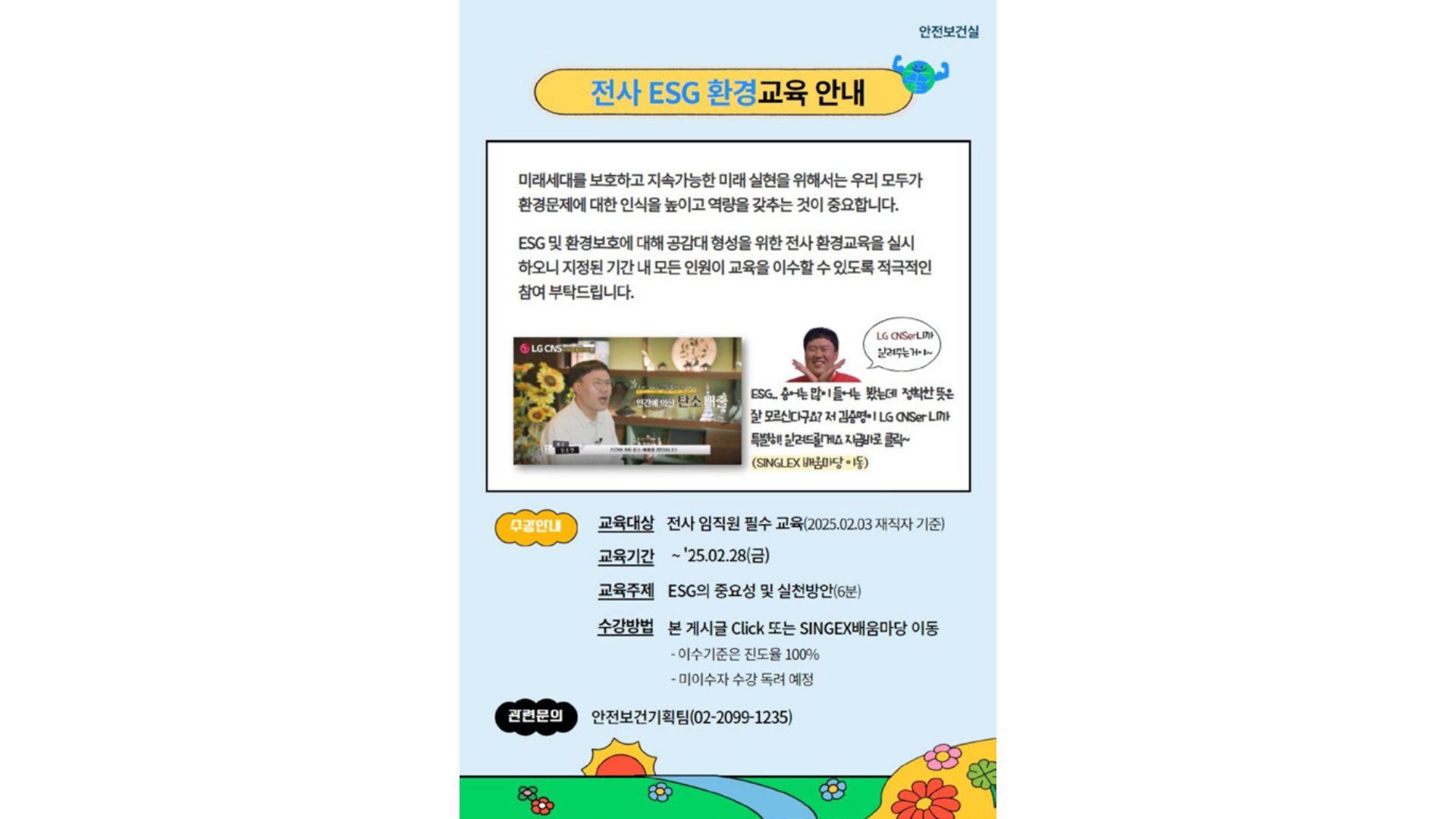
2025 ESG Environmental Education Notice
LG CNS participates in a used hand towel recycling campaign at our headquarters to promote a circular economy and contribute to reducing carbon emissions. Centered at the Magok headquarters, this initiative establishes a system for collecting and recycling used hand towels. More than 20,000 employees from nine LG affiliate companies within Magok LG Science Park, including LG CNS, are participating in the campaign. Through active employee participation, we expect to advance ESG management practices and raise awareness of the importance of responding to the climate crisis.
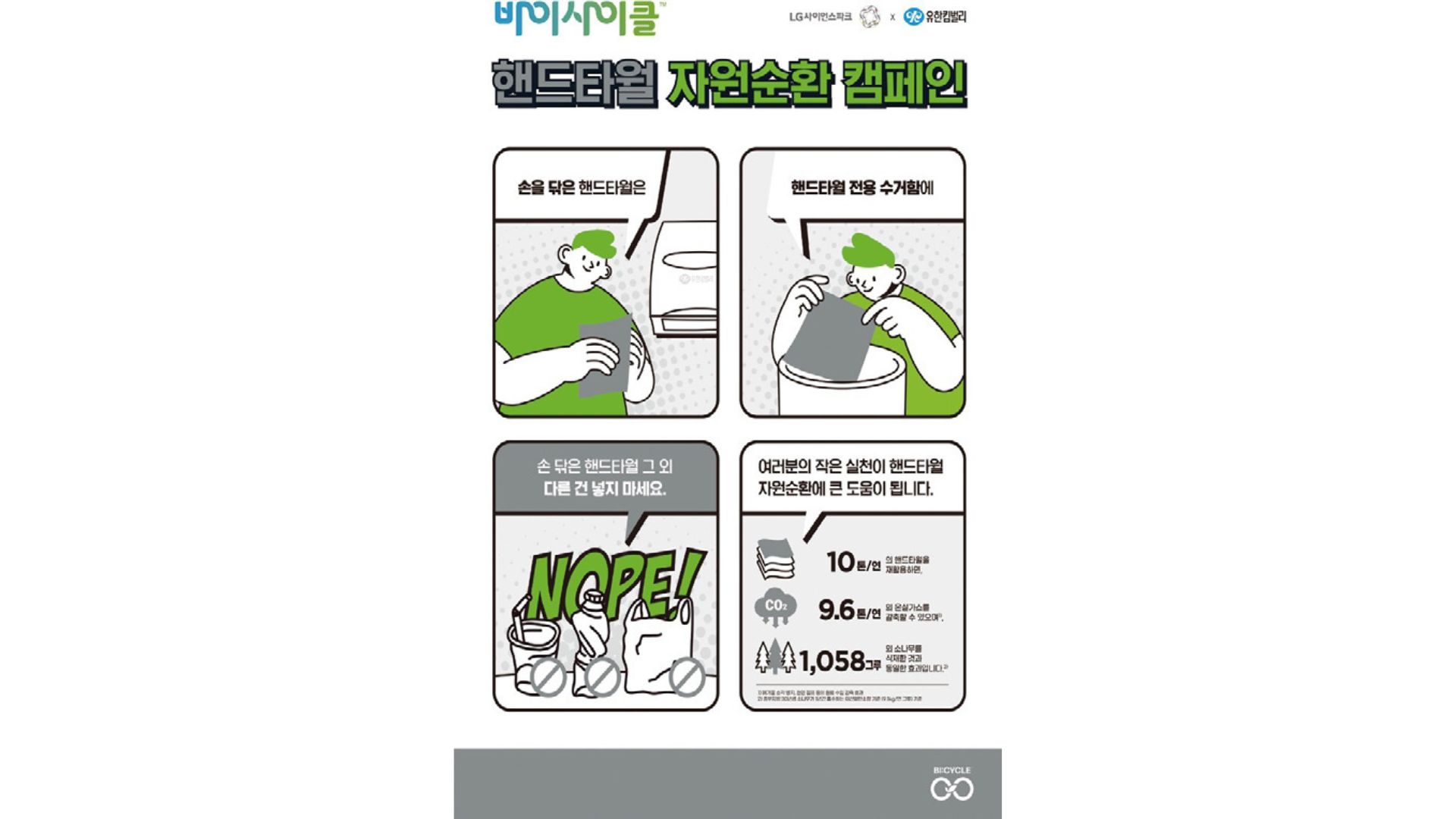
BI:CYCLE Campaign Poster
LG CNS systematically manages environmental issues at its major business sites in compliance with applicable environmental laws and regulations and company policies. However, we have identified varying levels of environmental management capabilities among our partner companies. By sharing our environmental management expertise with them, we are working together to create sustainable workplaces.
To help enhance their environmental management capabilities, LG CNS regularly visits key sites, including operational sites, to provide consulting support, enabling partner companies to build and internalize their own environmental management capabilities. In particular, we focus on encouraging their voluntary participation in environmental improvement efforts by sharing a wide range of best practices and providing training. We also offer tailored solutions that take into account the specific characteristics of each site, rather than applying a one-size-fits-all approach.
At its Yangsan operational site, LG CNS operates facilities that generate steam by burning fossil fuels, resulting in emissions of air pollutants such as nitrogen oxides (NOx). Environmental Management Capability Enhancement Program, LG CNS is working with partner companies to expand pollution-control facilities and enhance operational measures to reduce NOx emissions. We will continue to collaborate with our partner companies toward achieving our target by 2030.
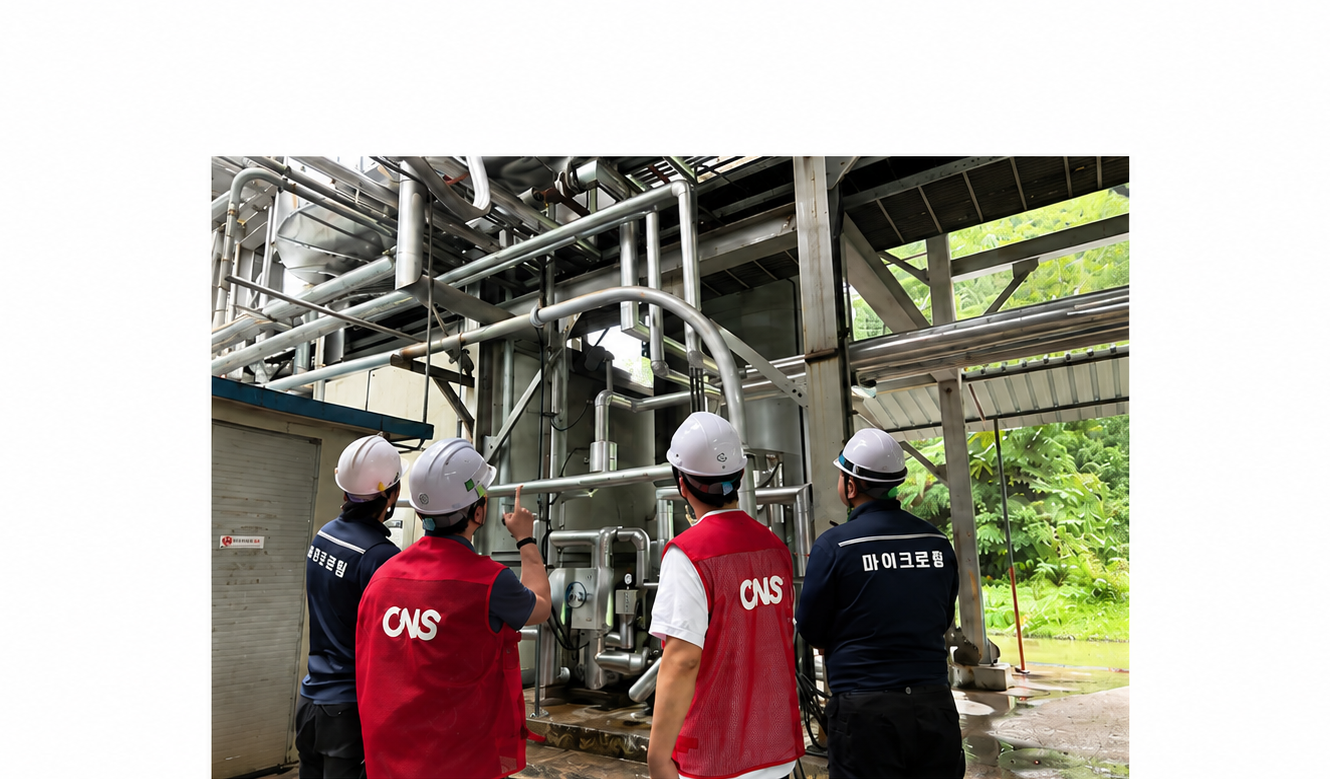
LG CNS employees inspecting environmental management practices
at a partner company’s site
As part of our ESG initiatives, LG CNS develops and operates Aimos, an AI-based steel scrap grading platform designed to advance resource circulation systems. By replacing subjective visual inspections with data-driven AI analysis, Aimos achieves a grading accuracy exceeding 85–90%, ensuring greater objectivity and consistency in quality control. Through continuous learning, Aimos enhances its grading performance and automatically decides whether to approve or reject incoming steel scrap, improving both operational efficiency and transparency. Looking ahead, we plan to expand its application to non-ferrous metals such as aluminum, as well as waste materials, thereby leading the implementation of an AI-powered resource circulation ecosystem.
Environment_Aimos_1219.png)
LG CNS has developed Enerdict, an AI-based integrated power plant optimization solution designed to improve the efficiency of power generation resources and contribute to carbon emission reduction. Enerdict predicts the power output of various generation resources, such as solar, wind, and fuel cells, along with electricity market prices. Based on these forecasts, it formulates optimal generation and storage strategies to maximize operational efficiency and profitability. By comprehensively analyzing weather forecasts, equipment conditions, and power market data, the solution provides real-time visualization of AI model-based prediction results, thereby enhancing operational stability and responsiveness. Moving forward, we plan to expand Enerdict’s application beyond power plants to broader energy demand sectors, including buildings and industrial complexes, driving the adoption of AI-based management systems for a sustainable energy transition.
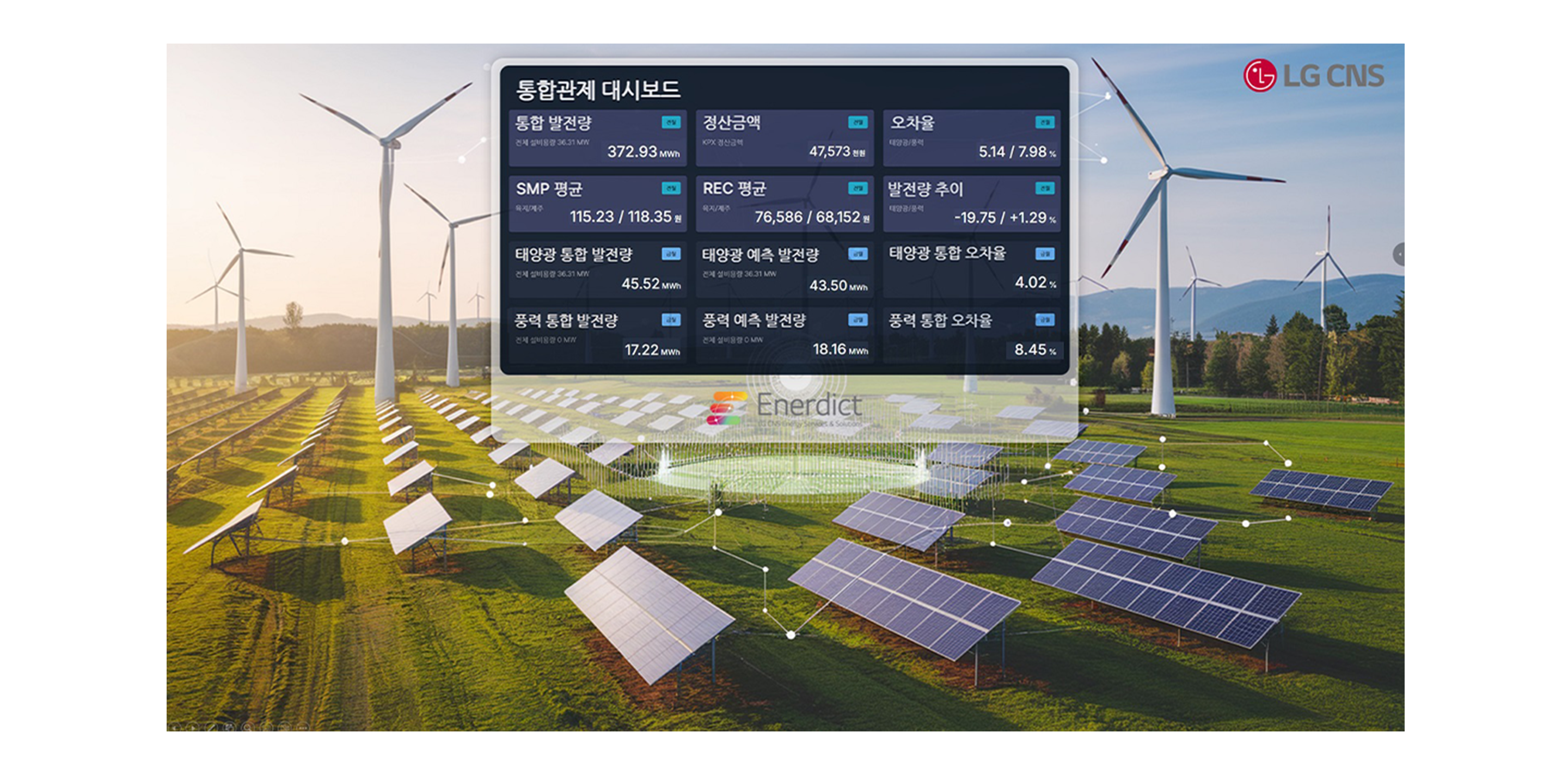
ESGV2_환경경영_enerdict_resized.png)
To advance sustainable management throughout its value chain, LG CNS is engaged in a wide range of sustainable economic activities, including smart factory solutions, logistics robots, smart farms, smart cities, and resource recycling. Each business activity focuses on systematically managing energy use and improving resource efficiency. Through these efforts, LG CNS aims to contribute to positive environmental impact, including climate change mitigation and the transition to a circular economy.
Going forward, LG CNS will continue to enhance the capabilities of its existing services and gradually expand their application scope. The company will also increase their adoption across a wider range of industries and deliver both environmental value and business outcomes.
LG CNS classified sustainable economic activities in accordance with the alignment assessment process set out in the revised K-Taxonomy published by the Korean government. Based on the K-Taxonomy Guidelines (Ministry of Climate, Energy and Environment, December 2025), LG CNS calculated K-Taxonomy-aligned performance for selected business activities and investments and voluntarily discloses the results in this report.
(Unit: KRW million)
| K-Taxonomy Classification | Relevant Economic Activity | 2025년 | ||
|---|---|---|---|---|
Revenue | CapEx 1) | OpEx | ||
| Manufacture of Materials, Components, and Equipment for Innovative Items | Autonomous manufacturing smart factory solutions, intelligent machines, smart farms, EV charging infrastructure, smart lighting, etc. | 639,409 | - | 36,321 |
| Manufacture to Utilize Core Technologies for GHG Reduction | Integrated Operation of Distributed Energy Resources and Flexible Resources (Renewable Electricity) | 1,490 | - | 400 |
| ICT Solution Development and System Implementation and Operation | Smart Transportation Platforms, Resource Recycling | 5,504 | - | 253 |
| Establishment and Operation of GHG Reduction Facilities and Infrastructure Related to Buildings | Building Management | 259 | - | - |
| Total | 646,662 | - | 36,975 | |
1) Due to the nature of its business, LG CNS recorded no CapEx related to economic activities under the K-Taxonomy.
LG CNS is pursuing a transition of its business areas toward sustainable products and services.
To this end, we are investing in R&D and infrastructure improvements for sustainable services, and plan to further expand these efforts in the future.
To this end, LG CNS plans to leverage AI to enhance existing services and identify new ones, while establishing systematic processes to ensure that these services can be developed and operated on an ongoing basis rather than as one-off projects.
In addition, we are conducting training for employees who develop and operate services, and through this, sustainable service revenue is expanding.