■ Participants from the U.S., U.K., China, Japan and beyond establish the competition as a global stage for optimization
■ From Stanford and Carnegie Mellon to Accenture and IBM: Top Minds from Universities and Companies Worldwide Join the Contest
■ LG CNS, Korea’s only company specializing in mathematical optimization, has solved more than 200 complex business challenges
LG CNS has concluded the Optimization Grand Challenge 2026, Korea’s only mathematical optimization competition, and held an awards ceremony.
Mathematical optimization is a technology that evaluates vast numbers of possible scenarios within given resources and constraints to identify the most efficient solution. It is considered a foundational technology underpinning next-generation industries such as AI, quantum computing and robotics. To broaden participation in the field, LG CNS has co-hosted the competition annually with the Korean Institute of Industrial Engineers since 2024.
This year’s competition saw a significant increase in participation. Entrants from 55 countries—including the U.S., U.K., China, Japan, Germany and India—gave the event a truly global profile just three years after its launch. The number of teams grew approximately 2.8-fold, from 343 last year to 958, while the number of participants more than doubled from 676 to 1,448. Participants from leading international universities—including Carnegie Mellon University, Imperial College London, Stanford University and the University of Tokyo—competed alongside those from major Korean institutions such as Seoul National University, KAIST and POSTECH. Industry professionals from global and Korean companies, including Accenture, IBM, Samsung Electronics and Hyundai Motor Company, also joined the competition.
This year’s challenge focused on optimizing the placement of shipbuilding blocks in a shipyard. Because very large vessels cannot be constructed in a single piece, hundreds of massive structural sections known as “blocks”—each potentially as large as a building—are fabricated separately and then assembled. Teams were tasked with developing algorithms to determine where, when and in what orientation each block should be placed within a limited workspace, maximizing space efficiency while keeping construction on schedule.
The challenge is considered one of the most complex problems in shipbuilding because every block differs in size and shape, while sequencing constraints require one process to be completed before the next can begin. Whenever a team submitted an algorithm, the automated evaluation system immediately calculated its score and posted the result on a real-time leaderboard.
After the preliminary and main rounds, the top six teams advanced to the finals held in Korea. The finalists presented the algorithms they had developed to solve the shipyard block-placement problem, competing on the logic and completeness of their solutions. The judging panel determined the final rankings based on a comprehensive assessment of both the presentations and algorithm performance.
A team from Japan took the grand prize. LG CNS awarded a total of KRW 200 million in prize money to 20 winning teams, including the grand-prize winner. Based on their rankings, winners will also receive either internship opportunities that may lead to employment or exemptions from initial resume screening when applying to LG CNS. In addition, all algorithm source code submitted by the top 10 teams will be released as open source. By sharing the diverse approaches developed during the competition with academia and industry, LG CNS aims to expand the adoption of mathematical optimization and support the continued growth of its ecosystem.
LG CNS has led the field of mathematical optimization, solving more than 200 business challenges across industries including shipbuilding, defense, steel, logistics and transportation, manufacturing and process engineering, finance, telecommunications and mobility, and aviation. Recent projects include optimizing material stacking and crane operating schedules for steelmakers; routes and charging schedules for airport guide, patrol and self-check-in robots; and painting schedules for shipbuilders, helping clients improve operational efficiency.
One notable project reduced warehouse inventory at a major Korean manufacturer by more than half. Indoor and outdoor air-conditioning units must be shipped as matched sets, but because the two types were produced at different rates, unmatched units accumulated in the warehouse. LG CNS applied mathematical optimization to precisely synchronize their production schedules, reducing inventory passing through the warehouse by 57% and achieving cost savings of several hundred million Korean won.
LG CNS’ Optimization Consulting team, which leads these projects, provides end-to-end expertise spanning data analytics, mathematical optimization and strategy consulting. It has approximately 50 master’s- and doctoral-level specialists, representing the largest pool of mathematical optimization experts in Korea.
“Maximizing efficiency with limited resources is highly complex and difficult, but mathematical optimization can offer a solution,” said Sangkyun Park, Senior Vice President of LG CNS’ Entrue Unit. “We will continue to grow the competition and expand the horizons of optimization technology together with talented people from around the world.” (END)
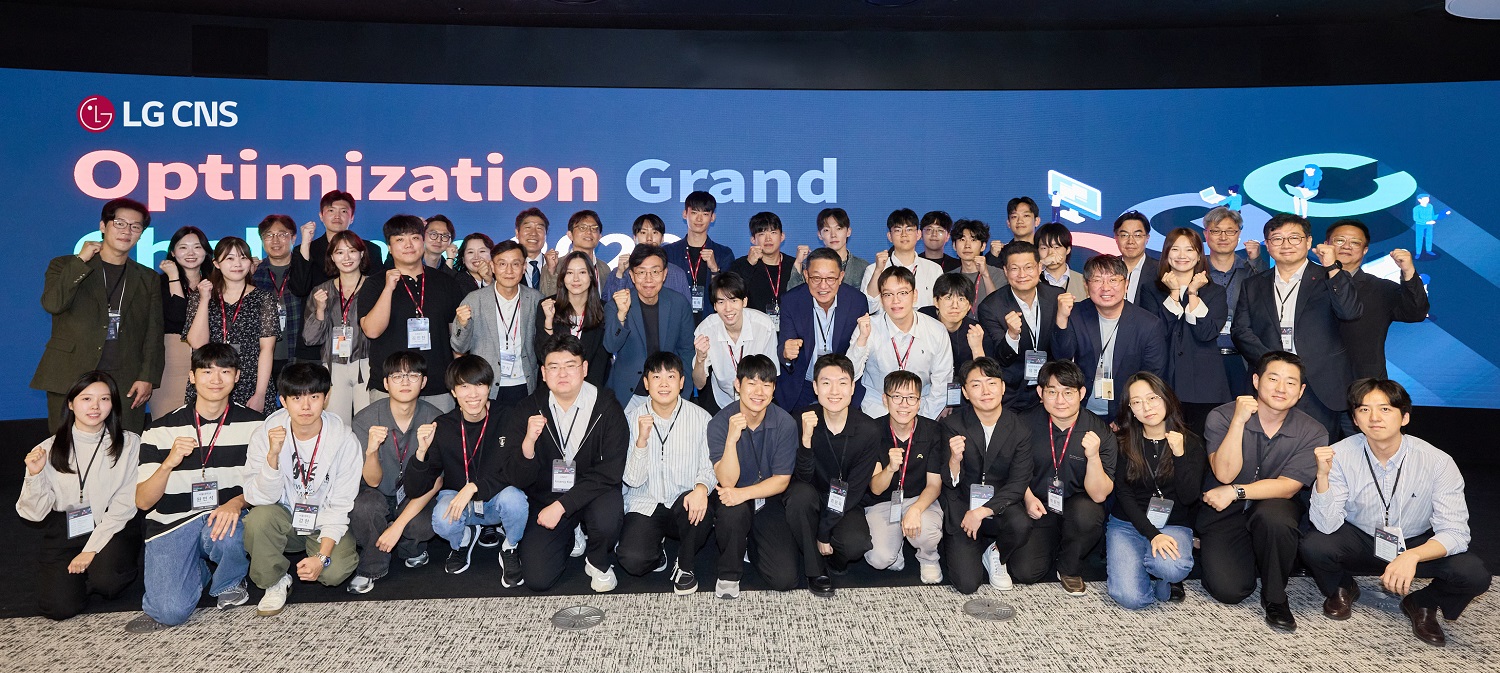 [Photo] Winners and officials pose for a group photo following the awards ceremony
for the Optimization Grand Challenge 2026, hosted by LG CNS.